Sotogrande: Designing for Space, Cork Oaks and Old Money
Why Sotogrande gardens follow a different set of rules to Marbella — and how to design with the cork oak canopy.
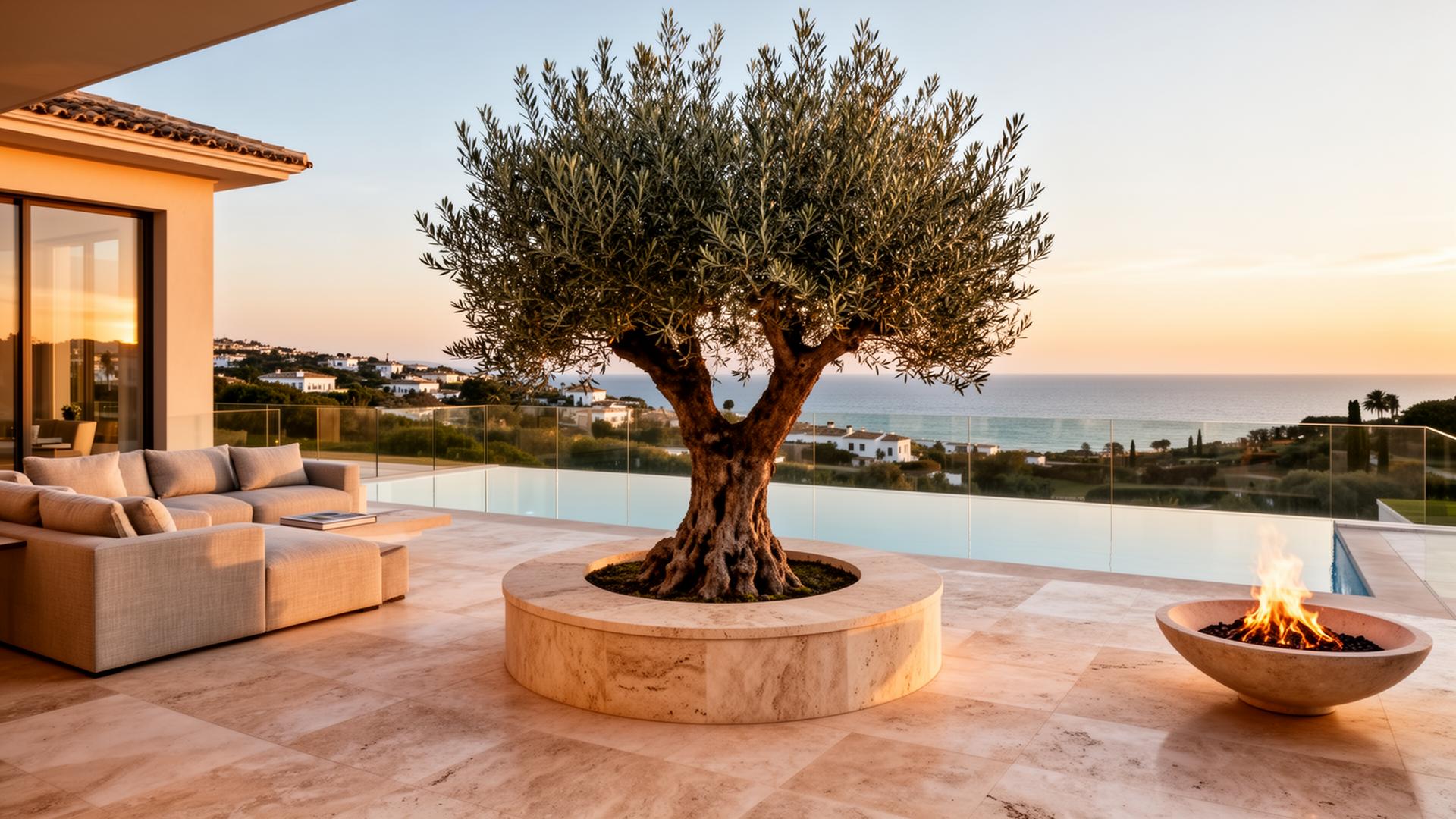
Sotogrande is the quietest luxury address on the coast, and its gardens show it. Plots are larger, mature cork oaks are protected, and the prevailing taste runs to restraint rather than spectacle. A design that reads as elegant in Marbella can read as loud here.
It's also a genuinely different microclimate. The Poniente and Levante both arrive with force, humidity is higher near the marina and the river, and frost is not unheard of in the valley on a January night.
The cork oaks come first
The alcornocales — Andalusian cork oaks — are the defining feature of Sotogrande Alto and much of the Kings & Queens area, and many are protected. They also dictate the design: root protection zones limit where you can excavate, and the dappled canopy changes what will grow beneath.
We survey and map every mature specimen before drawing a line. Terraces are then floated over root zones on pad foundations rather than poured slabs, and planting under canopy is chosen for shade tolerance — ferns, acanthus, viburnum, hellebore — rather than fighting it with sun-lovers that will sulk.
Scale up, decorate down
On a 3,000m² plot, small gestures vanish. The successful Sotogrande gardens we admire are built from a handful of very large moves: one long stone terrace, one generous water element, one avenue, one grove. Detail is reserved for the places you touch — a bar face, a step nosing, a gate.
Golf, polo and the horizon line
Many plots back onto a fairway or a polo field, and the borrowed landscape is worth more than anything you can build. Boundary planting should frame the view in two or three places and screen the rest, rather than form an unbroken hedge along the whole length.
Where the boundary is a fairway, we also design for stray balls: no full-height glass on that elevation, and seating positioned behind planting rather than in front of it.
Humidity, frost and material choice
The river valley holds moisture, and that changes specification. Untreated softwood will not last. Limestone with high porosity will green on the shaded side. We default to granite setts, dense travertine, oiled oak with generous ground clearance, and bronze or marine-grade stainless fixings throughout.
The Sotogrande evening
Because plots are deep and dark, lighting matters more here than anywhere else on the coast. We keep it low, warm and sparse: uplighting on three or four cork oaks, buried path lights at ankle height, and candles everywhere else. The aim is to leave the sky visible — a night sky is an amenity in Sotogrande in a way it no longer is in central Marbella.
Common questions
- Can you build near a cork oak in Sotogrande?
- Cork oaks are frequently protected and have root protection zones that restrict excavation. Terraces near them should be built on pad foundations that float over the roots rather than poured slabs, and any works usually require survey and approval.
- How does Sotogrande differ from Marbella for garden design?
- Plots are larger, the mature cork oak canopy shapes the layout, humidity is higher near the river and marina, and the prevailing style is far more restrained — fewer, larger gestures rather than dense detail.
Planning something similar?
Book a free design consultation.
Thirty minutes with our design team — no obligation, no charge.
Book your consultation →